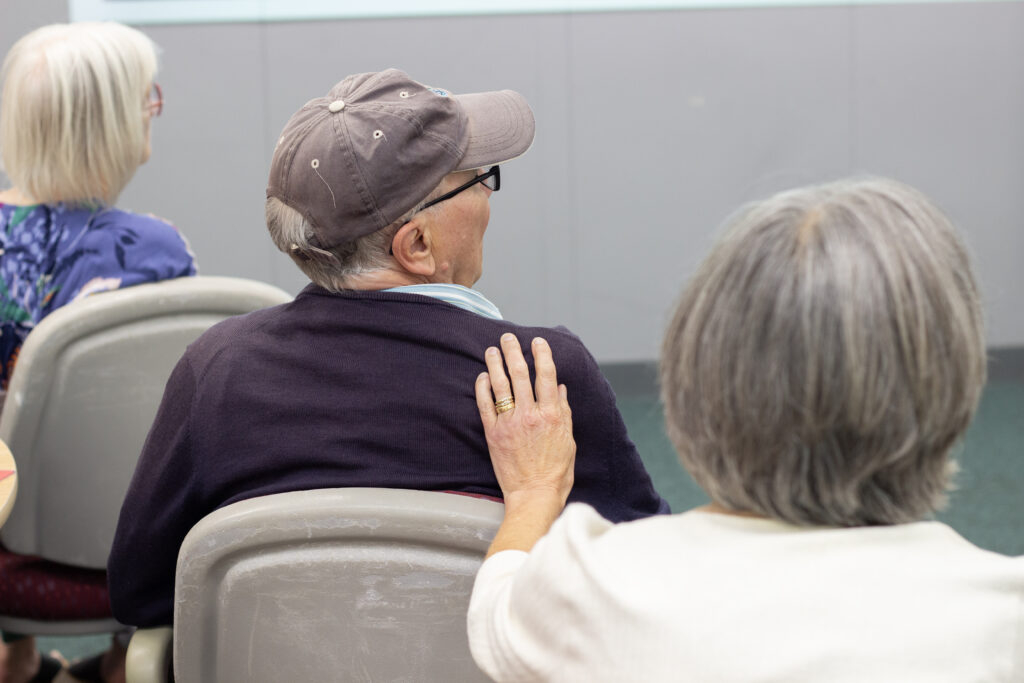
Our Befriending Volunteering Service reduces isolation and provides much needed emotional support to people living with PSP & CBD at different stages of their journey. We are lucky to have such dedicated volunteers who provide such vital support to our people. We wanted to provide you with some helpful tips for how to start conversations with people with PSP or CBD and their carers and families.
Tips for starting a conversation with someone who has PSP or CBD
- If you’re meeting someone with the conditions face-to-face for the first time, it’s a good idea to arrange a quiet space and time so that they feel comfortable and safe.
- Before meeting someone for the first time, find out some information about them so that you can engage them with something familiar that might help them open up more
- When meeting someone at their home or nursing home, look around their space for photos, certificates, or collections of artefacts that you can prompt them about that could start a good conversation.
Jon, one of your Befrienders recommends this: “My role here is very much about companionship and helping him stay connected to his life and interests. He follows everything we talk about, whether that’s engineering (about which I know very little, but he used to be an IT engineer)”
Tips for starting a conversation with carers of family Members
- Approach every conversation with empathy: it’s important to be aware of what the carer or family members have been going through and approach them in a caring way.
- Focus on the carer: carers and family members spend so much time looking after and caring for their loved one. Shifting the focus onto their wellbeing and away from their loved one’s illness can help open them up more.
- Use open-ended questions: this will allow them to share as much or as little as they want to.
- Listening is just as important: don’t feel that you always have to give advice, a listening ear goes a long way.
- Bring their attention to something positive: ask them about something that has brought them joy recently.
- Be specific when speaking about support: if they are needing additional support or wanting to find out what support might be available, try to narrow it down and take it step-by-step so they don’t feel overwhelmed.
Practical tips for approaching a conversation with someone with PSP or CBD
- Speak clearly and slowly, using short sentences.
- Reduce distractions: switch off the TV or radio so that they can focus on the conversation without distractions.
- Get on their level: Position yourself in front of them at eye-level, to accommodate for reduced vertical eye movement which is a common symptom.
- Be patient: It’s important to be aware of slower speech patterns that people with PSP & CBD may have. So, when engaging in a conversation, give them time to answer questions in their own time. Don’t cut them off or prompt them to answer quicker, let them take their time to feel as comfortable as possible.
- Acknowledge you have heard them: even if they haven’t answered your question directly or have gone onto another topic, show them you have heard them and encourage them to speak more about their answer.
- Give them simple choices: avoid creating complicated choices or options for them so they don’t feel overwhelmed.
- If they’re struggling to answer a question, pause and reassure them it’s ok and allow them to pick up the conversation when they’re ready
- Watch for non-verbal cues: Pay close attention to their facial expressions, gestures, and body language to pick up a cue if they’re not responding.
Another of our Befriender’s, Kam, uses a mixture of techniques to engage the people she supports, “Because she struggled to talk, she would email me what she wanted me to read and I’d read it out. “With the second person it was a mixture of talking things through and helping with paperwork, such as applying for Neuro Heroes physiotherapy sessions through PSPA. Over time, our conversations became more about her week, her appointments and how her PSP was progressing.
Tips for adapting as the disease progresses
- Use alternative tools: If their speech is becoming slurred or faint, try using a whiteboard and pen or notebook and pen, picture boards or communication charts.
- Yes and no signals: Create a system for communication such as “thumbs up” for yes and “thumbs down” for no.
- Don’t assume they don’t understand: just because they can’t respond, doesn’t mean they don’t understand. Give them time to respond in a way comfortable to them.
We understand how difficult it can be for the person who has PSP or CBD to communicate as their going through their journey. The most important thing to remember is to be kind, patient, and open-minded. You all do such amazing jobs as Support Group Coordinators, Befrienders, Micro Volunteers, Support Group Helpers, and Helpline volunteers. We hope these tips will help you start and keep the conversation going.